Tuition Class Batch Scheduling Is a Constraint-Satisfaction Problem
The real job of tuition class batch scheduling is preventing conflict
A tuition owner does not need a calendar; they need a promise that Tuesday 6 pm will never collide with the science batch sitting at the same desk with the same teacher. Every timetable change touches families who have arranged dinner, tuition and transport around it, so the cost of a conflict is not a rescheduled hour — it is twelve parents who now doubt the whole system. Tuition class batch scheduling is best treated as a constraint problem with a hard layer you never break and a soft layer you negotiate, which is exactly how SWIQ models availability behind an online booking link.
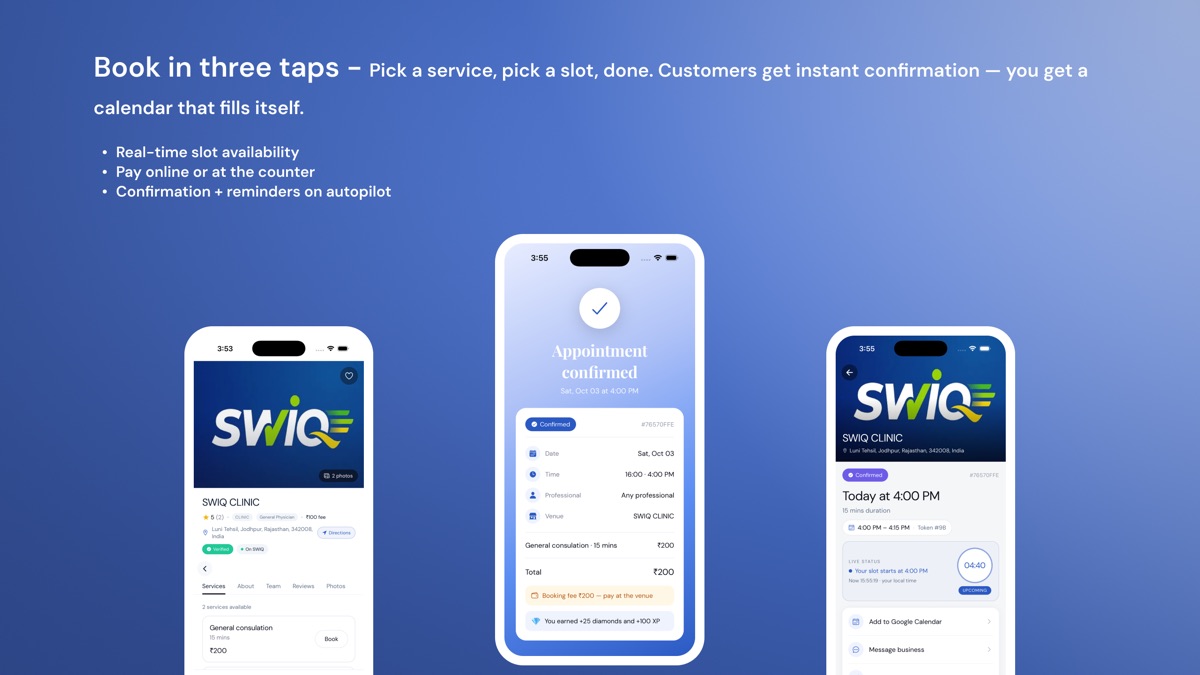
The four entities and their relationships
The model needs four things: the batch (a stable group at one level), the teacher, the subject or topic, and the slot — day, start time, duration, desk or room. A session is a join of batch × slot × teacher; capacity lives on the batch, not on the room, because two students at one desk is a teaching problem, not a seating one. Students belong to a batch, not to a slot, which is what keeps a timetable change from becoming a per-student edit. Getting this right is half the work, and the other half is the slot discipline in our appointment booking checklist for clinics — same idea, different room: define the slot, its length and its owner before you publish it. Half of tuition class batch scheduling is simply refusing to model a relationship you will not maintain by hand.
Hard constraints versus soft preferences
Hard constraints: the teacher is free, the room is free, no batch overlaps itself, and no teacher is booked twice in one hour. Soft preferences: siblings study on the same evening, younger students avoid the slot right after school, exam-week revisions sit close to the exam. Solve the hard set first, then place as many soft preferences as remain, and write both lists down in that order — because the fastest way to lose a parent is to promise a soft preference as though it were a hard one. When the sets conflict, the hard list wins silently and the soft list gets explained honestly.
Capacity, waiting lists, and the batch that fills overnight
Cap the batch deliberately: at a single desk, twelve students is the point where a teacher can still look at every paper. When the cap is hit, the batch shows as full and new enquiries go to a waitlist in enquiry order, so promotion when a seat frees is a decision rather than a race in the parents' group chat. Capacity is where tuition class batch scheduling turns into customer service: the enquiry order is the fairness rule, and it only exists if something recorded it. Sometimes the answer is not a bigger batch but a second one at a neighbouring hour, and the waitlist becomes the seed list for it. This promotion-in-order logic is the same pattern our queue management system note describes for walk-ins arriving after a counter is full.
Fees, UPI links, and seats that expire
A seat held without payment is a seat held twice. Send the batch fee as a UPI payment link alongside the confirmation, hold the reserved seat for 24 hours, then release it to the waitlist if nothing arrives — politely, once, with the payment link included again. Decide the billing shape before the term starts: monthly keeps entry cheap but doubles your reconciliation work, while quarterly suits a batch that already trusts you. Either way, the rule that prevents arguments is that the seat status and the payment status are one record, not two that someone must remember to compare.
Edge cases: exam weeks, merged batches, festival holidays
Exam weeks change durations, not just dates: revision sessions run longer, so the service needs its own length or every estimate for that evening is wrong. Merges look harmless until two batches share one teacher in one hour — that is a hard conflict, and merging is only legal if the combined count stays under the cap or the room changes. Holidays are the quiet failure: a recurring schedule that shifts each cancelled session by a week drifts into another batch's slot by Diwali. Skip the date, never shift it, and let the waitlist absorb any student who wants a make-up.
Moving a batch time without breaking twelve families
Announce before you move: propose the new slot, message the families on WhatsApp, and ask each to reply yes or no rather than to "let us know". Replies are data — if three families decline, the move costs more students than it saves, so open a second batch instead of relocating the existing one. In SWIQ experience, a change sent seven days ahead with one clear question keeps almost all students, while the same change sent two days ahead with an open-ended message loses the ones whose parents never get around to replying.
Where SWIQ fits
SWIQ is booking and queue software for Indian businesses; the parts a tuition uses — an online booking link for enquiries, service and staff calendars, a waitlist that fills freed seats, WhatsApp confirmations and reminders, UPI payment links, and basic analytics on batch fill — ship as one product rather than four apps stitched together. Plans run ₹777 / ₹1,777 / ₹2,499 a month, the first 300 bookings are free, and the 14-day free trial needs no card; setup takes about 2 minutes. See swiq.services. If you are comparing tuition class batch scheduling tools, ask which of the four entities they model; the answer tells you whether you are buying a timetable or a calendar. Details are also on the landing page, and the Jodhpur team answers on WhatsApp at +91 79002 60076 with advice on laying out your own.
Comments
Join the discussionNo comments yet. Be the first to comment.